

Health vs Term Insurance Explained :Which One Do You Really Need?
We often hear the words “health insurance” and “term insurance” thrown around by family members, financial advisors, or even ads on television. While both fall under the broad umbrella of financial protection, they serve two completely different purposes. Mixing them up—or worse, thinking having one means you don’t need the other—is a common mistake that can leave families vulnerable.
If you have ever found yourself confused about Health vs Term Insurance Explained, you are not alone. Many people in India struggle to differentiate between these two critical financial tools. One pays for your hospital bills while you are alive, and the other secures your family’s future if you are no longer around. Understanding the difference isn’t just about financial literacy; it’s about ensuring your family’s safety net is complete.Health vs Term Insurance Explained
In this guide, we will break down the differences, benefits, and reasons why you might actually need both.
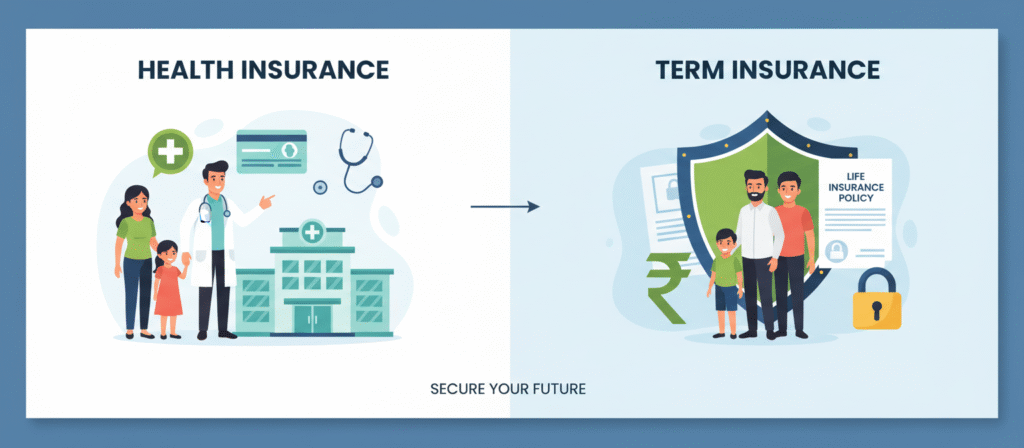
What is Health Insurance?
Health insurance is a type of coverage that pays for medical and surgical expenses incurred by the insured. In simple terms, if you or a family member falls ill or gets injured, the insurance company covers the treatment costs up to the sum insured.
With rising medical inflation in India, a single hospitalization can wipe out years of savings. Health insurance acts as a shield against these high costs. It typically covers hospitalization charges, pre- and post-hospitalization expenses, ambulance costs, and sometimes even day-care procedures. It ensures that you don’t have to compromise on the quality of healthcare due to a lack of funds.
What is Term Insurance?
Term insurance is the purest form of life insurance. Its primary goal is financial protection for your dependents. If the policyholder passes away during the policy term, the nominee receives a lump sum amount (the death benefit).
Unlike investment-linked insurance plans, term insurance does not usually offer maturity benefits if you survive the term (unless you opt for a Return of Premium plan). Because it is a pure risk protection plan, the premiums are significantly lower compared to other life insurance products. It is designed to replace the breadwinner’s income, ensuring that the family can continue to pay rent, school fees, and daily expenses even in their absence. Health vs Term Insurance Explained
Term Insurance vs Health Insurance Which Is Better?
When people ask, “Term Insurance vs Health Insurance Which Is Better,” the answer isn’t about picking a winner. It is about understanding that they solve different problems. You cannot compare apples to oranges, and similarly, you cannot compare a plan that protects your health to a plan that protects your life.
If you are hospitalized, a term plan won’t pay a single rupee. Conversely, if the policyholder passes away, a health insurance policy will stop (or only cover remaining family members) without providing a lump sum for the family’s future survival. Therefore, “better” is the wrong word. Both are essential. Health insurance is for now (medical emergencies), and term insurance is for later (security in your absence). For a complete financial safety net, most earning individuals need both.
Health Insurance and Term Insurance Comparison
To make things clearer, let’s look at a direct Health Insurance and Term Insurance Comparison. This table highlights the fundamental distinctions between the two.
| Feature | Health Insurance | Term Insurance |
|---|---|---|
| Primary Purpose | Covers medical expenses and hospitalization costs. | Provides financial security to the family in case of the insured’s death. |
| Benefit Payout | Pays the hospital (cashless) or reimburses medical bills. | Pays a lump sum amount to the nominee upon death. |
| Who Benefits? | The policyholder and covered family members (while alive). | The nominee/family members (after the policyholder’s death). |
| Duration | Usually renewed annually. | Long-term coverage (e.g., 20, 30, or 40 years). |
| Tax Benefits | Section 80D of the Income Tax Act. | Section 80C of the Income Tax Act. |
| Survival Benefit | No specific maturity benefit (except No Claim Bonus). | No maturity benefit (unless Return of Premium option is chosen). |
Health vs Term Insurance Explained Understanding this comparison helps you realize that these products complement each other rather than compete.
Difference Between Health and Term Insurance in India
The Difference Between Health and Term Insurance in India also extends to how tax laws treat them. Under the Income Tax Act, the government encourages citizens to have both by offering separate deductions.
For Term Insurance, the premiums paid are eligible for tax deduction under Section 80C, up to a limit of ₹1.5 lakh per year. This section also includes other investments like PPF and ELSS. On the other hand, Health Insurance premiums are deductible under Section 80D. You can claim up to ₹25,000 for yourself and your family, and an additional ₹50,000 if you pay premiums for senior citizen parents. This distinct separation in tax laws reinforces the fact that the Indian financial system views both as necessary pillars of personal finance.
Health Insurance vs Term Plan Benefits
When analyzing Health Insurance vs Term Plan Benefits, we must look at the specific advantages each brings to your financial portfolio.
Benefits of Health Insurance:
- Cashless Treatment: Access to network hospitals without paying upfront cash.
- Financial Protection: Saves you from debt during medical emergencies.
- Preventive Care: Many plans now offer free annual health check-ups.
- No Claim Bonus: For every claim-free year, your coverage amount increases. Read more about No Claim Bonus Health Insurance to understand how this works.
Benefits of Term Insurance:
- High Cover at Low Cost: You can get a cover of ₹1 Crore for a very affordable monthly premium if you start young.
- Debt Protection: If you have a home loan or car loan, the payout can settle these debts so your family doesn’t lose assets.
- Peace of Mind: Knowing your family’s lifestyle won’t crash if something happens to you.
- Riders: You can add benefits like Accidental Death Benefit or Critical Illness cover for extra protection.
Who Should Buy What?
Still wondering what to prioritize? Let’s look at some practical scenarios common in Indian households.
Scenario 1: The Young Professional (Age 24)
Rohan has just started his first job. He doesn’t have dependents yet.
- Priority: Health Insurance. An accident or dengue hospitalization could wipe out his small savings.
- Secondary: Small Term Plan. Since premiums are lowest at this age, locking in a term plan now is a smart move, even if dependents come later. Health vs Term Insurance Explained
Scenario 2: The Family Man (Age 35)
Vikram is married with a 4-year-old daughter and a home loan.
- Priority: Both. He needs Medical Insurance to protect his savings from hospital bills. However, Term Insurance is non-negotiable because his family relies on his income to pay the EMI and school fees. Health vs Term Insurance Explained
Scenario 3: The Retiree (Age 60)
Mrs. Iyer has retired. Her children are independent.
- Priority: Health Insurance. As age increases, health risks rise. Term insurance is generally not required if there are no financial dependents or liabilities, and getting a new term policy at this age is very expensive.
Frequently Asked Questions (FAQs)
1. Can I use term insurance to pay hospital bills?
No. Term insurance only pays out upon the death of the policyholder. It does not cover medical bills. For hospital expenses, you need a dedicated health insurance policy.
2. Is critical illness cover the same as health insurance?
Not exactly. Critical illness cover (often a rider on term plans) pays a lump sum if you are diagnosed with a specific illness like cancer or heart failure. Health insurance reimburses the actual hospitalization bills.
3. If I have a corporate health plan, do I still need personal health insurance?
Yes. Corporate plans are linked to your employment. If you leave your job or retire, you lose the cover. Having a personal policy ensures continuous coverage. Health vs Term Insurance Explained
4. Can I claim tax benefits for both policies?
Absolutely. You can claim deductions under Section 80C for your term plan and Section 80D for your health plan simultaneously.
5. What happens if I outlive my term insurance policy?
In a standard term plan, you do not get any money back if you survive the term. It is a pure risk protection tool. However, the peace of mind it provides during those years is the real return on investment.
The Final Verdict
When we look at Health vs Term Insurance Explained, the conclusion is simple: they are the two wheels of your financial bicycle. You need both to move forward safely. Health insurance protects your current wealth from medical expenses, while term insurance protects your family’s future wealth in your absence.
Ignoring either can leave a gap in your financial planning. According to the Insurance Regulatory and Development Authority of India (IRDAI), penetration of insurance in India is still growing, and awareness is key to securing your family’s future.
Don’t wait for an emergency to realize the value of insurance. If you are unsure which plan fits your budget or needs, we are here to guide you like a family member.
Need help choosing the right plan?
Click here & Let Us Help! or expert at Insurance Mart today.

